
It's about Time
Head's up – This one gets a little nerdy

I’ve always enjoyed physics — the feeling when a complicated idea suddenly makes sense at an intuitive level. I was recently given a book about Time. It pulled me back into the physics of time.
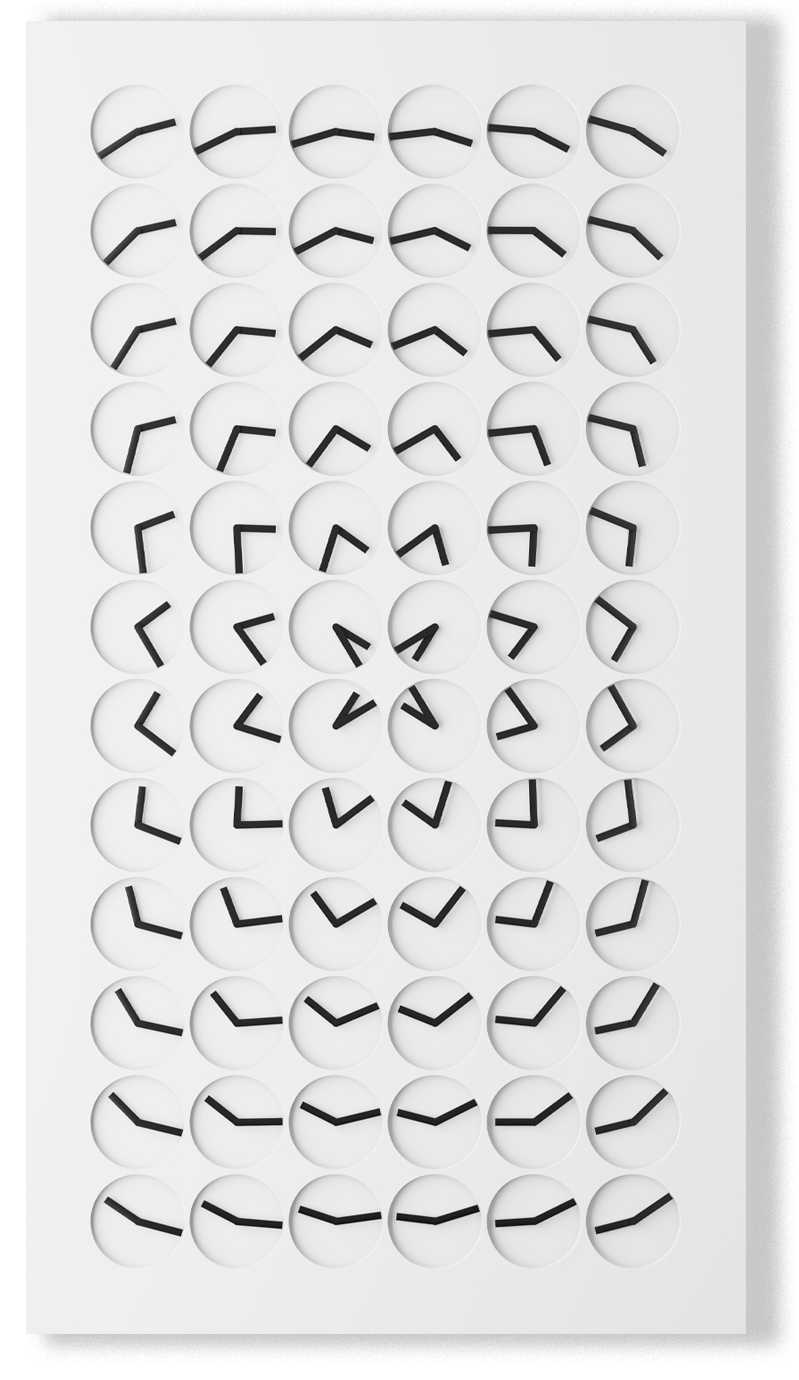
A couple of years ago I managed to build an intuitive understanding of why time slows down at high speeds. This piece is an attempt to extend that intuition into a broader framework—one that connects relativity, gravity, and entropy using a single idea — Causality.
Time as a measure of Causality
Every way we measure time is a way of measuring change - oscillations of quartz crystals, pendulums, moving hands on a clock, sand emptying out, sun moving in the sky - change is rooted in cause and effect. Said another way, when there is no cause or effect of change, there is no time. Therefore a useful way to think of time is as a measure of change, cause, effect - time as a measure of causality.
Causality has a speed limit
Physics tells us that there is a maximum speed at which information can travel through the universe: the speed of light, usually written as c.
Light isn’t special because it’s light. It’s special because it has no mass. Due to the lack of mass it travels at the maximum possible speed. Put differently, this maximum speed is the fastest information can travel — fastest that a cause can produce an effect. So we may think of c not as “the speed of light,” but really as the speed limit of causality. Electromagnetic waves being massless, happen to be the only phenomena to be able to reach this maximum limit.
Why Causality slows at high speeds
With the above two ideas in place, let’s examine the famous experience of slower aging and slower passing of time when travelling at very high speeds.
Imagine you’re in a rocket and moving comparably fast to the speed of causality - let’s say at 50% speed of causality. And you’ve left your sibling on earth at the regular speed. You age through the billions of internal processes—atoms vibrating, molecules reacting, cells repairing, signals firing. All of that is cause and effect happening inside you.
The constraint of causality on your entire systems is that none of the atoms and molecules in you - that is their internal motion added to the speed of the rocket - none of them can independently cross the speed limit of causality. And so your internal processes physically slow down due to this limit. Since internal processes are the cause of aging, you age more slowly compared to the experience of causality for your sibling on earth.
Makes sense right? This is Einstein’s Special Relativity.
Why Causality slows near large mass
Next let’s examine the observation that time slows down near large masses like planets, suns, and black holes even when you’re standing still.
As a thought experiment, for time to be slowing down, something must be happening between cause and effect itself. It’s getting thicker like a viscous liquid. Or it’s getting folded up like the folds of mountains. Or it’s taking longer to compute to resolve all the dense cause and effect linkages from all the particles around it.
If we take these observations and add the counter observation from earlier - that if we slow the rocket down, we will age faster - it has to mean that the speed of causality is not a limit. It has to be a constant. Because if it were not a constant, below the limit, causality should be observed at various speeds. But we observe causality to be constrained in its behaviour.
The parallel of this idea in theoretical physics is the Four Velocity constant. Which is the description of the movement of an object through spacetime - 3 dimensions of space and 1 dimension of time is a constant. This along with the description of spacetime’s geometry, and extending this influence of gravity also to energy - is Einstein’s General Relativity.
Why causality has a direction
The third seemingly disconnected piece of physics to time is entropy. Entropy is why we seem to observe the arrow of time from past to future. Physicists say that there isn’t directionality in fundamental equations. That is, if we observe a video of a pool table with one ball striking two others or play it back in reverse - we wouldn’t know which of the two is the real footage. Because both are possible and describable in physics.
We only are able to tell time when an ordered state of a system leads to disorder. Disorder doesn’t naturally lead to order. That is, milk and coffee don’t unmix naturally, rocks don’t reform from dust naturally, the sun doesn’t collect light and become hotter naturally.
In terms of Causality - cause tends to dissipate and diffuse into effects - from states of high concentration like the sun to states of complete diffusion like the heat death of the universe. From a solid single rock into many miniscule particles of dust.
Putting it all together
Time is change - cause and effect - causality.
Causality diffuses at a constant rate from states of high causal concentration to low causal concentration. [constant speed of causality + arrow of time]
Mass, speed, and energy distort the causal links, causing perceived causality to slow down - relative to an area without mass, speed or energy. [general and special relativity]
The causality based reframing feels lighter and simpler. Though I wish to find a more intuitive explanation of the third point - where does the distortion that mass and gravity imposes on causality come from, and why. And what is the nature of the concentration and diffusion of causality. I can’t help but wonder if there’s an underpinnings of an idea here I can flesh out further into something more mathematical and comprehensive at some point.
That’s all for now. Thanks for reading!
References
Slightly more technical explanations: